Therapy Practices
Visitor Assistant signs clients in on a tablet in your lobby, and the confirmation the client sees at the end carries no name. The therapist is told by email, SMS or Teams — that notification is not covered by the no-name assurance — A paper sheet, by contrast, carries every earlier name down the page.
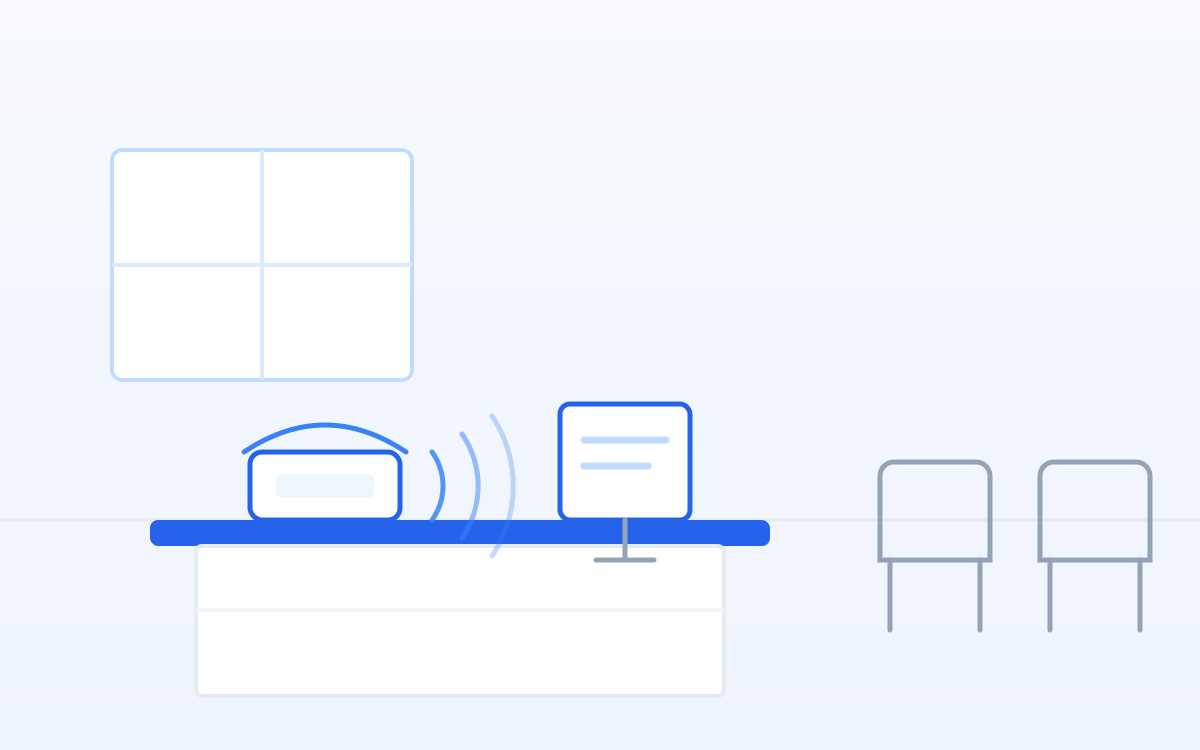
You have four therapists and no front desk. There is a clipboard by the door with a paper sign-in sheet on it, and the next person to walk in can read every name above their own. When someone is greeted by name, it happens in front of whoever is sitting there. Your clients are the reason you are careful — some of them worry about running into someone they know on the way in, and in a small town that is not a hypothetical. You do not want a receptionist. You want nobody to have to say why they are here, or hear their own name said out loud.
It is not better because it is a screen — we have no evidence for that claim and we are not going to make it. It is better because of what is on the screen and for how long. The confirmation a client sees when they finish carries no name, and the questions before it are only the ones you wrote, so if you do not ask why someone is here, nothing on the glass says why anyone is here. A paper sheet carries every earlier name down the page, in front of whoever signs next.
No. You write the check-in questions yourself, and there is no reason-for-visit field unless you put one there. Photo capture, ID check and spoken questions are each off until you turn them on, so with spoken questions left off the client answers by typing and nothing is read back aloud. A practice can run a check-in that asks nothing more than a first name and who the person is here to see.
In Ontario, the IPC states the PHIPA definition this way: personal health information is identifying information, oral or recorded, relating to the provision of health care to an individual, and identifying information includes information that could reasonably be used to identify someone. Our reading, not the IPC's, is that a name on a psychotherapy practice's sign-in sheet meets that definition, because the context of the sheet is the disclosure. You may read it differently. Either way it is worth deciding on purpose rather than by habit.
CRPO's Standard 3.1 does not address a lobby sign-in sheet or a check-in screen. It does address handing reception work to someone else: requirement 3.1.3 says registrants relying on others to provide reception or other administrative support train and supervise them on matters of confidentiality and privacy. If you replace a receptionist with software, that is the requirement you are answering to, and the answer lies in how you configure the check-in and who can see the arrival record.
Staff are told by email, SMS or Teams. The no-name assurance is about the client-facing confirmation on the tablet, and we do not extend it to the staff notification — we would rather you plan around that than be surprised by it. A notification face-up on a phone left on a table is the same shoulder-surfing problem moved one room over, so where your therapists keep their phones between sessions is worth deciding deliberately.
That is your switch: keep them, clear them after a number of days you choose, or clear them at the end of the visit. The IPC's position is that PHIPA sets no specific retention periods and directs custodians to their governing legislation for applicable requirements, with one thing it does require: records of personal health information must be kept long enough to allow an individual to exhaust any legal recourse regarding an access request. So clearing at the end of the visit is a setting we offer, not advice. We do not recommend a number; the period is yours to choose and to be able to defend.
Everything is processed in the United States — there is no Canadian region — and what is kept, for how long, and what that means for a health information custodian is set out on our privacy page. This page describes Ontario law; other provinces have their own statute and their own regulator.
Before: a clipboard on the ledge inside the door of a four-therapist counselling practice, one column of names growing through the day. The person arriving at four can read everyone who came at two, and a client who passes a neighbour in the corridor has already been on paper for six hours. After: the ledge holds a tablet. The same client types a first name and who they are here to see, and the screen says the therapist has been told and to take a seat. That is all it says — no name, nothing the next person in the queue can use. The therapist's phone buzzes between sessions. Photo capture, ID check and spoken questions stay off, because a corridor shared with two other businesses is not a place for a talking tablet. The arrival record is set to clear at the end of the visit, and the practice writes down why it chose that, since the period is theirs to defend. The intake paperwork gains a line saying arrival information is processed in the United States. What has not changed is that a screen can be read over a shoulder. What changed is how much is on it, and how long it stays. (An illustration we have written, not a customer.)
You write the questions, so you decide what is asked. Some practices ask for a first name only, some ask for initials and an appointment time, some ask who the person is here to see. Ask for less and there is less on the screen to be read, and less in the arrival record afterwards.
A notification by email, SMS or Teams, depending on what you set up. The no-name assurance we make is about the confirmation the client sees on the tablet; we do not extend it to the staff notification.
No. Photo capture, ID check and spoken questions are each off until you turn them on. For a therapy practice with a shared waiting room, most of what makes a check-in feel exposing is the parts you can simply leave off.
That is a separate assistant. Voice Assistant answers the practice line, and what it does is set out on our Voice Assistant page. Visitor Assistant on its own is $99 a month in Canadian dollars; adding a second assistant makes it $149, and all three $199.
Setting this up is our work, not a form you fill in. We go through your wording with you, and you can change any of it afterwards.
 Digital Front Desk