 Digital Front Desk
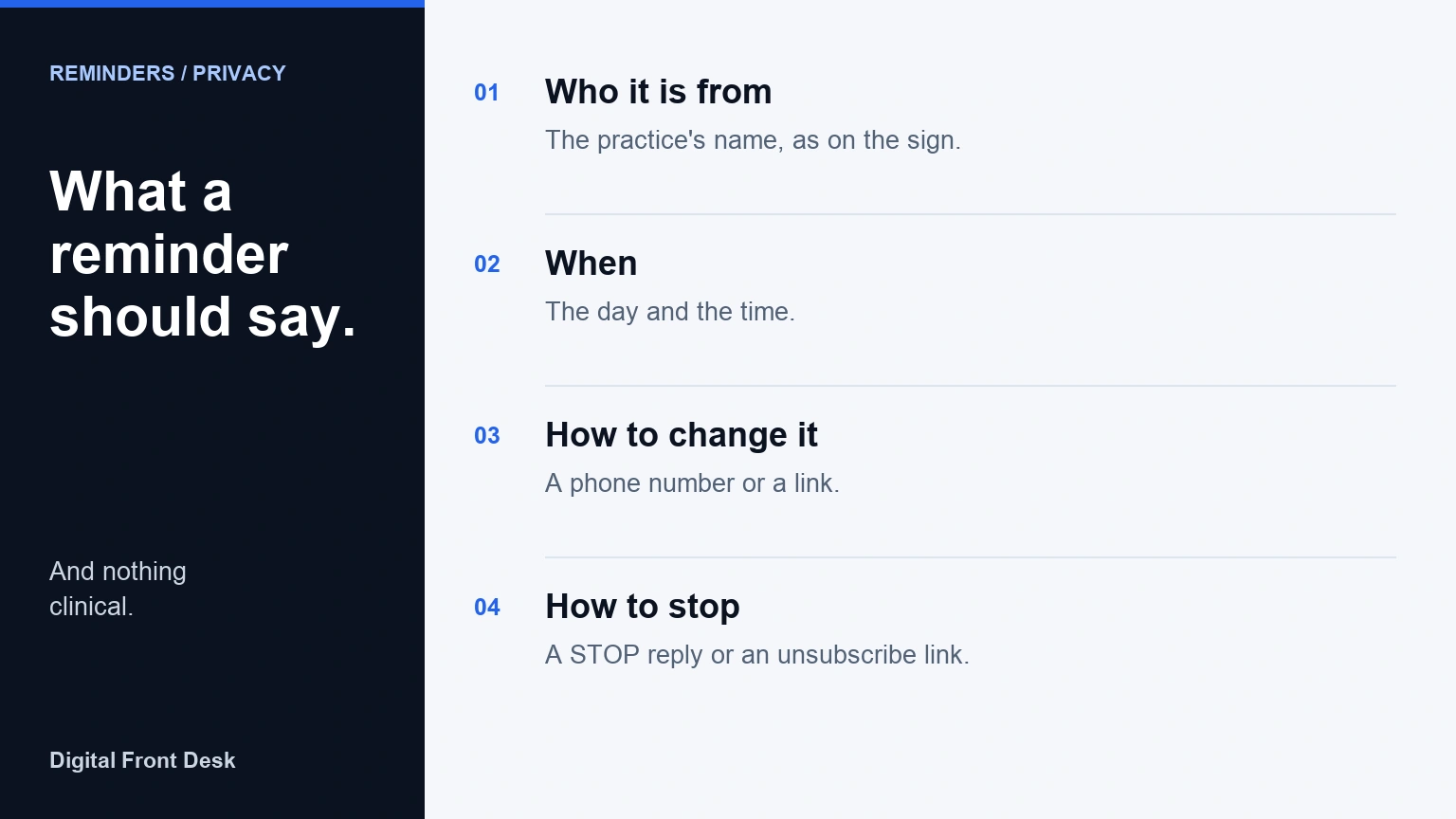
In Canada an appointment reminder is usually allowed without a separate signed permission, but it is not a message to write carelessly. For a health practice, the fact that someone has an appointment with you can itself be personal health information, so the safest reminder says who it is from, when, and how to change it, and nothing else.
This guide is for clinics, therapists, dental and allied health offices, and any practice that sends reminders by text, email or voicemail. It answers the questions people search for, often in American terms like "PHI" and "HIPAA", for the Canadian laws that actually apply. It is general information, not legal advice, and the rules differ by province and by profession.
Are appointment reminders personal health information?
Often, yes, for a health practice. Ontario's health privacy law, PHIPA, counts identifying information that relates to the provision of health care to a person, including identifying someone as a person a provider cares for, as personal health information (PHIPA, s. 4(1)). A text that says "your appointment with Dr. Lee's psychiatry clinic" tells whoever reads it that the recipient is a patient there.
That does not make reminders forbidden. It means the content should be the minimum needed, and the practice should think about who might read a lock screen, a shared inbox or a family voicemail box. The American term "PHI" comes from HIPAA, which does not apply to a Canadian practice; the Canadian equivalents are PHIPA in Ontario and the health information laws of the other provinces, with PIPEDA or a provincial private-sector law covering many practices outside them.
Do you need consent to send appointment reminders?
Two different laws ask two different questions, and it helps to keep them apart.
- Privacy law: may you use the patient's contact details this way? Health privacy laws generally allow a provider to use information for the purpose it was collected for, and a phone number given when booking is usually given so the practice can reach the patient about that booking. How that works in detail depends on your province and profession; ask your college or privacy adviser.
- Your college: may you use this channel? Ontario's physicians' college expects encrypted communication for personal health information where possible, and express, informed consent before using unencrypted email or text for it (CPSO, Protecting Personal Health Information). Where a patient has no encrypted option, it says the office should generally limit messages to information without identifiable health details, "such as reminders or scheduling" (CPSO Dialogue). The Ontario College of Pharmacists gives the same advice to pharmacies (OCP, 2023).
The practical reading: a plain reminder with no clinical detail is the kind of message the colleges point to as low-risk. Anything more, such as results, treatment details or a diagnosis, needs a secure channel or the patient's informed consent. Ask each patient at booking how they want to be reminded, and record the answer.
CASL: are reminders commercial messages?
Canada's Anti-Spam Legislation (CASL) governs commercial electronic messages: texts and emails that encourage someone to buy something. A reminder about a time the patient already agreed to is mainly about that agreement, not a sales pitch, and CASL says so in its own terms. The consent rule in s. 6(1)(a) does not apply to a message that solely "facilitates, completes or confirms a commercial transaction" the recipient previously agreed to (CASL, s. 6(6)).
Two cautions. First, the exemption is from consent only: the message must still identify the sender and offer a way to unsubscribe (s. 6(2)), so name the practice and include a stop option. Second, the word "solely" matters. A reminder that also advertises a promotion, or a "you're due for a cleaning" message to someone with no booking, is a different message. CASL allows implied consent from an existing business relationship, such as a purchase of a service within the two years before the message (s. 10(10)), and beyond that you need express consent.
What to leave out of a reminder text, email or voicemail
Write every reminder as if the wrong person will read or hear it, because sometimes they will.
| Include | Leave out |
|---|---|
| The practice's name, as on the sign | A department or specialty that reveals a condition, if your name allows a neutral version |
| The day and time | The reason for the visit, the treatment, or the test |
| How to change it: a phone number or a link | Results, diagnoses, medication or anything from the chart |
| A way to stop reminders | The practitioner's name, where it reveals the type of care (your call) |
| The patient's first name, if you choose | Health card numbers, dates of birth or other identifiers |
Voicemail. A message left on a home phone may be heard by anyone in the house. Leave the practice name, a request to call back and the number, and keep the appointment details to the call itself unless the patient has said a detailed message is fine. If a patient has asked you not to leave messages, note it where everyone at the desk will see it.
Group and shared accounts. Confirm the number or address belongs to the patient, not a parent, partner or employer, and update it when they tell you it has changed.
Ask at booking, and write it down
Most reminder problems are avoided by one question when the appointment is made: "How would you like us to remind you: text, email, a call, or not at all?" Record the answer, along with whether a detailed voicemail is acceptable. Patients in sensitive situations, such as counselling, sexual health or someone whose household should not know about their care, will tell you if you ask, and rarely will if you do not.
Keep a record of each stop request and honour it in every system that sends messages, including any your staff send by hand from a personal phone, which is best avoided entirely.
Other provinces and professions
Ontario has the most published guidance, which is why it is quoted here. Other provinces have their own health information laws, and several colleges publish their own expectations on electronic communication. Read your own college's policy before choosing what your reminders say, and check whether a reminder vendor processes information outside your province or outside Canada, because some laws and some colleges ask you to tell patients or to assess that first.
How Digital Front Desk handles reminders
Digital Front Desk is one example. Its day-before reminder says who it is from, when, how to change it and how to stop; the reason for a visit is never in a message, and it cannot be added. Every text names the practice and ends with "Reply STOP to opt out", and the software itself honours a STOP reply. Texts go only from the practice's own Canadian number to Canadian mobile numbers, and somebody who has only ever phoned the practice is never texted; they get the email reminder if the practice has an address for them.
A reminder about a booked appointment is treated as a service message, which is why it goes without a recorded consent. A rebooking text to someone with no booking is treated differently: it goes only to a client who has consent on file or whose last visit was within two years, never more than once in 30 days, and a person presses send. Client records are stored in Canada and processed in Canada and the United States; reminder emails are sent through Zoho Mail in Canada and texts through Twilio in the United States, as set out in our privacy policy and subprocessors page.
The appointment reminders page shows the exact messages and copy-paste examples you can use with any system. Consent is still the practice's to hold and record.
Questions about reminders and privacy
Are appointment reminders allowed without written authorization in Canada?
Generally a plain reminder about a booking the patient made does not need a separate signed authorization, but your college may expect express consent before using unencrypted email or text, so ask how each patient wants to be reminded and record it.
Do appointment reminders count as personal health information?
For a health practice they often do, because the reminder shows that the person receives care from that practice. Ontario's PHIPA defines personal health information broadly enough to include that, so keep reminders to the minimum.
Does HIPAA apply to appointment reminders in Canada?
No. HIPAA is a United States law. A Canadian practice looks to its provincial health information law, such as PHIPA in Ontario, to PIPEDA or a provincial private-sector law, and to its regulatory college.
Do appointment reminder texts need CASL consent?
A message that solely confirms or facilitates an appointment the person agreed to is exempt from CASL's consent rule, but it must still identify the sender and include a way to unsubscribe. Adding promotions changes that.
What should I say in a reminder voicemail?
Leave the practice name, a request to call back and the phone number. Keep appointment details for the conversation unless the patient has told you a detailed message on that phone is acceptable to them.
Can a patient stop appointment reminders?
Yes, and they should be able to do it easily. Include a stop option in every text and email, honour it in every system you send from, and call the patient yourself if a booking matters.
See the messages
The appointment reminders page has the messages Digital Front Desk sends, copy-paste examples for any practice and a short section you can share with patients. You can try it free with your own appointments.
This article is general information about Canadian privacy and anti-spam rules, not legal advice. Law and college guidance were checked on 20 October 2026; your province and college may differ.