 Digital Front Desk
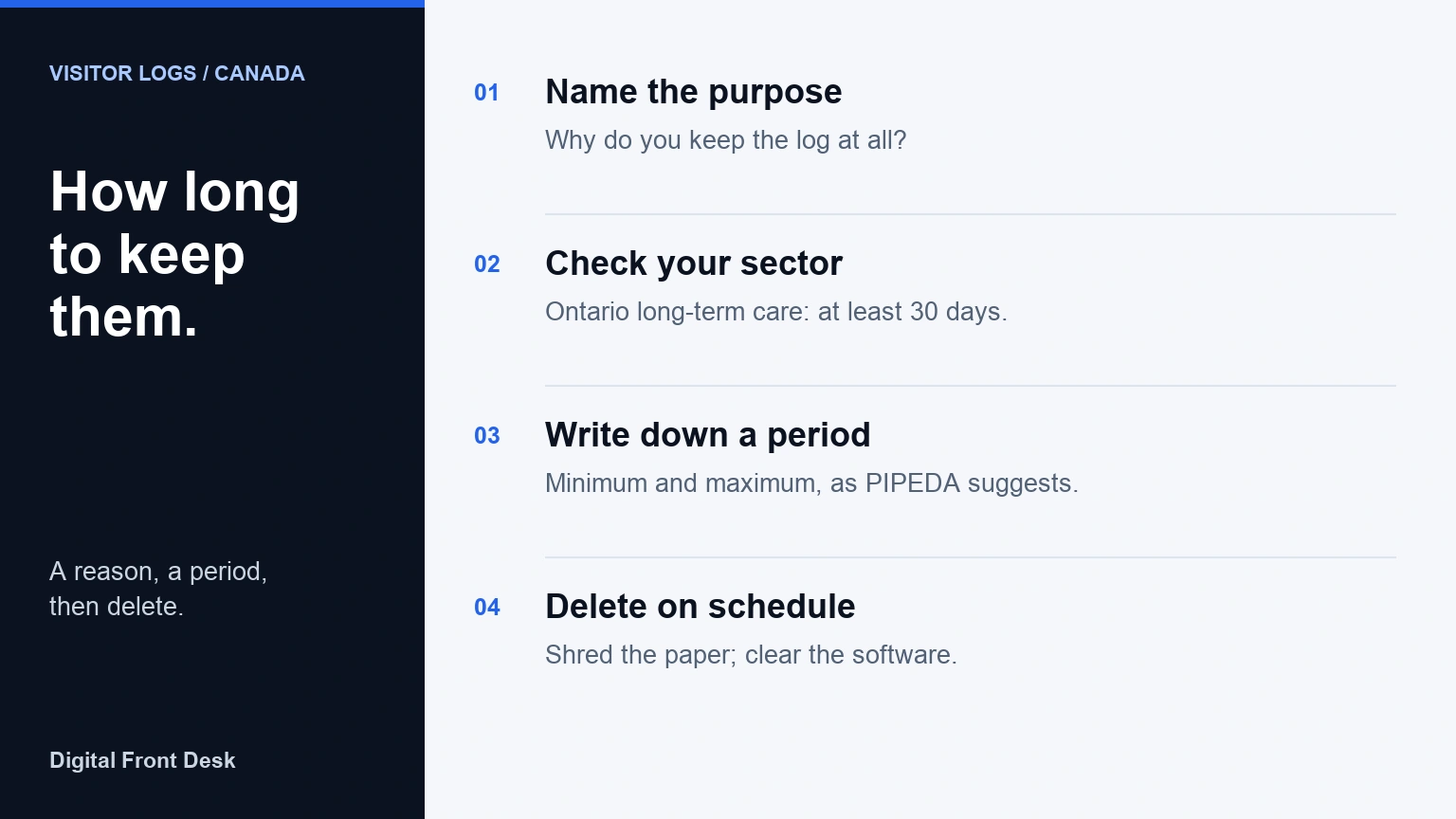
In most of Canada no law gives a visitor log a fixed number of days. The rule is a principle: keep a sign-in record only as long as the reason you collected it needs, then destroy it. A few settings add their own rules. Ontario long-term care homes, for example, must keep visitor logs for at least 30 days.
This guide is for offices, clinics, care homes and worksites in Canada deciding how long to keep paper sign-in sheets or a digital visitor log. It sets out what the federal and provincial privacy laws say, the settings with extra rules, and a simple way to pick and write down a period. It is general information, not legal advice; the law varies by province and sector.
The short answer
- There is usually no fixed period. Privacy laws ask you to keep personal information only as long as you need it for the purpose you collected it for, and then to destroy it or make it anonymous.
- Some sectors set a minimum. Ontario long-term care homes must keep visitor logs for at least 30 days. A minimum is not a deletion date.
- Write your period down. Federal guidance expects a retention policy with minimum and maximum periods, and a way to destroy records when the period ends.
What PIPEDA says about keeping records
PIPEDA, the federal private-sector privacy law, applies to personal information collected in commercial activity in most provinces. A sign-in record, with a name, a time and often a phone number, is personal information. Its fifth principle says personal information "shall be retained only as long as necessary for the fulfilment of those purposes" (PIPEDA, Schedule 1, clause 4.5).
The same clause adds three things that apply directly to a visitor log:
- Organisations should have guidelines and procedures for retention that "include minimum and maximum retention periods" (clause 4.5.2).
- Information used to make a decision about someone should be kept long enough for them to ask to see it (clause 4.5.2).
- Information no longer needed "should be destroyed, erased, or made anonymous", under procedures the organisation writes down (clause 4.5.3).
The Office of the Privacy Commissioner of Canada's guidance says the same in practical terms: set retention periods for each kind of personal information, review what you hold, and dispose of it securely (OPC, Personal Information Retention and Disposal).
Alberta, British Columbia and Quebec
These three provinces have their own private-sector privacy laws, which generally apply instead of PIPEDA to businesses operating within them. Each sets a principle rather than a number.
- Alberta. An organisation may keep personal information "only for as long as the organization reasonably requires" it for legal or business purposes, and within a reasonable time afterwards must destroy it or make it non-identifying (Personal Information Protection Act, s. 35).
- British Columbia. Information must be destroyed, or made anonymous, as soon as it is reasonable to assume it no longer serves its purpose and is not needed for legal or business purposes. If you used it to make a decision that directly affects someone, keep it for at least one year after that decision (Personal Information Protection Act, s. 35).
- Quebec. Once the purposes are achieved, the business must destroy the information or anonymize it, subject to any preservation period another law sets (Act respecting the protection of personal information in the private sector, s. 23).
For an ordinary visitor log, the one-year rule in British Columbia rarely applies, because signing someone in is not usually a decision about them. If you do use the log to decide something about a person, such as banning them from the building after an incident, ask your adviser how long to keep that record.
Ontario long-term care homes: at least 30 days
Ontario's long-term care regulation is the clearest rule we found for visitor logs. It says every licensee "shall maintain visitor logs for a minimum of 30 days", recording the visitor's name and contact information, the time and date of the visit, and the resident visited (O. Reg. 246/22, s. 267(2)).
Thirty days is the floor. A home's visitor policy, records policy or public health unit may ask for longer, and the privacy principle still applies at the other end: keep the log for a reason, not forever. Our free Ontario LTC visitor log lays out the required fields and quotes the regulation in full.
Clinics and health settings
In a clinic, a sign-in sheet can show who is a patient. Ontario's health privacy law requires a health information custodian to ensure records of personal health information are "retained, transferred and disposed of in a secure manner" and in line with any prescribed requirements (PHIPA, s. 13(1)). If a patient has asked for access to their information, it must be kept until they have used every recourse the Act gives them (s. 13(2)).
Your regulatory college's rules on how long to keep patient records are written for the clinical record. Whether a lobby sign-in sheet falls under them is a question for your college or privacy adviser. The safer design is to keep health details off the sign-in altogether, so the log is a short list of names and times you can clear quickly.
Hospitals, worksites and contractor logs
Hospitals. We found no single Canadian rule that sets how long a hospital keeps its visitor logs. Hospitals usually set the period in their own records policy, under the privacy law that applies to them. If you are asking as a visitor, ask the hospital's privacy office.
Worksites and contractors. We also found no general workplace safety rule that fixes a retention period for visitor or contractor sign-in sheets. The usual reasons to keep them are practical: knowing who was on site during an incident or an evacuation, and showing that a contractor signed in and was given an orientation. If a log might be needed for an incident report, an insurance claim or a dispute, keep it until that matter is closed, then return to your normal period. Our contractor sign-in sheet and evacuation roll call sheet are free to print.
How to choose and write down a period
- Name the purpose. Most logs answer "who was here that day", for a lost item, a complaint or an evacuation. Some answer a rule, like Ontario LTC's.
- Check for a sector rule. Long-term care, health care, a licence condition, a contract or a public health order may set a minimum.
- Pick a minimum and a maximum. The minimum is what a rule or a real need requires. The maximum is when you destroy the record unless something specific requires you to keep it.
- Write it in your privacy policy or records policy, and tell visitors how long you keep their details if they ask.
- Destroy on schedule. Shred full paper sheets when they pass the maximum. In software, set the log to clear on the same schedule and check that it does.
Many general offices find a few weeks is enough to answer "who was here that day". That is a common practice, not a legal rule; pick what your own reason supports.
If you still use paper, our free visitor sign-in sheet collects only what a front desk needs, which keeps the question of retention small.
How Digital Front Desk handles retention
In Digital Front Desk the business chooses what happens to what a visitor typed: keep it, clear it after a set number of days, or clear it once the visit is over (or a day later if nobody checked the visitor out). Until you choose, it is kept, because deleting records is the step that cannot be undone. A single entry can be removed, or erased for good when someone asks, and the log can be downloaded as a CSV file if you need a copy before it clears.
Records are stored in Canada, with some processing in the United States, as our privacy policy sets out. What the software itself deletes on its own schedule is listed on our data retention page. You can see the visitor log and its settings on the visitor management page.
Questions about keeping visitor logs
How long must visitor logs be kept in Canada?
For most businesses no law sets a number of days. Privacy law says to keep the log only as long as its purpose needs, then destroy it. Some sectors set a minimum, such as 30 days for Ontario long-term care homes.
How long should you keep visitor sign-in sheets?
Long enough to serve the reason you keep them and meet any rule for your sector, and no longer. Write the period down, and shred full sheets once they pass it rather than filing them away indefinitely.
How long do hospitals keep visitor logs?
We found no single Canadian rule for hospital visitor logs. Each hospital usually sets the period in its own records policy, so the hospital's privacy office is the place to ask about a particular visit.
Is 30 days the most an Ontario long-term care home can keep a visitor log?
No. O. Reg. 246/22 says a minimum of 30 days. A home can keep logs longer if its policies or public health ask, but should still have a reason and an end date.
Do I have to delete visitor records when the period ends?
Privacy laws say information you no longer need should be destroyed or made anonymous. Keep a record past your period only for a specific reason, such as an open incident or a legal matter, and delete it once that is over.
Does a contractor sign-in log need to be kept longer than a visitor log?
Not by any general rule we found. Many worksites keep contractor logs longer because they show who was on site and who was oriented, which matters if there is an incident. Set the period by that reason.
Set a period you can keep to
Print the free visitor sign-in sheet or the Ontario LTC visitor log, or see how a digital log clears on your schedule on the visitor management page. For the wider privacy questions, read Visitor Data in Canada: Five Questions to Ask Before Choosing Check-In Software.
This article is general information, not legal advice. Law references were checked on the official texts on 20 October 2026.